Born in the Barracks: The True History of Kajukenbo in Hawaii
# Born in the Barracks: The True History of Kajukenbo in Hawaii
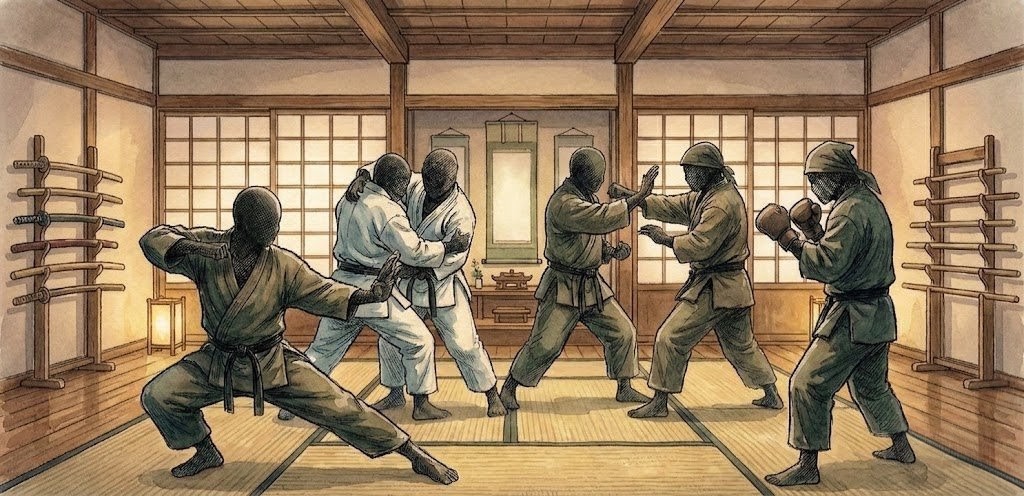
If you think Mixed Martial Arts (MMA) started in an octagon in the 1990s, you're missing a huge piece of history. Long before modern MMA hit pay-per-view, a group of five masters in Hawaii was already blending styles out of pure necessity.
This is the history of **Kajukenbo**, America's very first mixed martial art, born not for sport, but for survival on the rough streets of 1940s Oahu.
## The Palama Settlement: Where Tradition Met Necessity
To understand Kajukenbo, you have to understand the environment that created it. In the **late 1940s**, the **Palama Settlement** (also known as Palama/Kalihi) in Honolulu was a tough place. Post-war Hawaii was a melting pot of cultures, but it was also rife with violent crime. As historical accounts document, "fist-fights or stabbings were commonplace" in this poverty-stricken district.
Traditional martial arts were respected, but many practitioners felt they were too rigid for the unpredictable chaos of a street fight. You might know how to throw a punch, but what if you got tackled? You might know how to grapple, but what if there were two attackers?
The answer came from five men who called themselves the **Black Belt Society**.
## The "Black Belt Society" and the Five Founders
These five masters made a pact: they would train together, hide nothing, and test everything. If a technique worked in a real fight, they kept it. If it didn't, they threw it out. Their development of Kajukenbo spanned from **1945 to 1947**, with the official founding occurring in **1947** at the Palama Settlement.
The name **Kajukenbo** itself is a syllabic acronym representing the five arts that formed the system and the five founders who contributed them:
* **KA (Karate):** Contributed by **Peter Young Yil Choo**, a master of Tang Soo Do (Korean Karate), Shotokan Karate, and an accomplished boxer—he was a Hawaiian Welterweight Champion. He brought high kicks, striking speed, and Western boxing techniques.
* **JU (Judo & Jujitsu):** Contributed by **Joseph Holck** (Kodokan Judo and Danzan-Ryu Jujutsu) and **Frank F. Ordonez** (Sekeino-Ryu Judo). They provided the throwing, joint locking, and groundwork essential for neutralizing opponents close-up.
* **KEN (Kenpo):** Contributed by **Adriano Directo Emperado**, a master of Kosho Shorei-Ryu Kenpo and Escrima (also known as Arnis and Kali). He learned the 12 basic strikes of Escrima at age 11 from his stepfather and trained in Kenpo under the legendary Professor William K.S. Chow. He brought the rapid-fire hand strikes, fluid movement, and weapon disarmament techniques that became the "glue" of the system. Emperado is often credited as the **Sijo** (founder) who carried the art forward after the other four founders departed.
* **BO (Boxing):** Contributed by **Clarence Chang** (also known as George "Clarence" Chuen Yoke Chang), a master of Sil-Lum Pai Kung Fu (Chu'an Fa Kung Fu) and Chin Na. He added the circular, evasive movements and techniques of Chinese martial arts. (Note: Western boxing was also integrated through Peter Choo's background.)
## A Philosophy of Evolution
The genius of Kajukenbo wasn't just in mixing styles; it was the mindset. The founders operated under a simple but revolutionary principle: if a technique worked consistently on the street or against one another during training, it stayed in the system; if it did not, it was discarded. This pragmatic approach ensured the art remained focused on real-world self-defense rather than tradition or aesthetics.
When the founders opened the first public school in **1950**—the **Palama Settlement Kajukenbo Self Defense Institute (K.S.D.I.)**—the training became notoriously brutal. To ensure students could be "invincible on the streets," they engaged in full-contact sparring. The training was so intense that students routinely suffered broken bones, concussions, and exhaustion.
Adriano Emperado's philosophy reflected this uncompromising approach. He famously stated:
> *"The workout isn't over until I see blood on the floor."*
He also emphasized that *"the best teacher is pain."* His belief was that anyone afraid of pain would be defeated the first time they were hit. To survive and master Kajukenbo, one had to first experience pain to understand its application.
The system's philosophical motto captured its essence:
> *"Through this fist style, one gains long life and happiness."*
While it sounds peaceful, the path to that "long life" was learning to end a fight within seconds. It wasn't about scoring points; it was about going home safely to your family.
## The Korean War and Continuation of the Art
Shortly after Kajukenbo's conception in 1947, the Korean War broke out. In response, four of the five founders—Joseph Holck, Peter Choo, Frank Ordonez, and Clarence Chang—left Hawaii on active military service. This left **Adriano Emperado** as the sole founder to continue teaching the system.
Although Adriano was listed as the chief instructor, much of the day-to-day teaching was handled by his younger brother, **Joseph "Joe" Emperado**, who became instrumental in developing and refining the art.
To accommodate their poor students, the Palama Settlement school charged only **$2.00 per month** for training—a remarkable price that made martial arts accessible to the working class.
The reputation of this tough new art grew rapidly. As word spread of the effectiveness of Kajukenbo in street fighting, students flocked to train. By the early 1950s, Adriano Emperado had opened **12 Kajukenbo schools throughout Hawaii**, making it the second largest chain of schools in the islands at that time.
## Evolution and Expansion to the Mainland
In **1958-1960**, Kajukenbo began its expansion beyond Hawaii to the U.S. mainland, primarily California. **John Leoning**, a black belt student of Adriano Emperado, was among the first to bring the art to the mainland, opening a school at **Travis Air Force Base in California** in 1958. Other pioneering black belts from Emperado's schools—including **Joe Halbuna, Charles Gaylord, Tony Ramos, and Aleju Reyes**—opened their own Kajukenbo schools in California beginning in 1960, spreading the art across the Pacific Coast.
In **1959**, Emperado continued to evolve Kajukenbo by integrating more **Kung Fu techniques**, shifting the art toward a more fluid combination of hard and soft techniques. This adaptive approach became a defining characteristic of Kajukenbo.
In **1967**, several accomplished Kajukenbo practitioners—Charles Gaylord, Aleju Reyes, Joe Halbuna, Tony Ramos, and Al Dacascos—formed the **Kajukenbo Association of America (KAA)** to promote and standardize the art across the United States.
## Legacy and Modern Practice
Today, Kajukenbo is recognized worldwide as America's first mixed martial art and stands as a testament to Hawaiian innovation. The art continues to evolve, with each generation encouraged to develop their own "expression" of Kajukenbo rather than simply mimicking their instructors.
Modern Kajukenbo maintains its core focus on real-world self-defense and practicality. The system encompasses striking, kicking, throwing, takedowns, joint locks, and weapon disarmament. Practitioners are taught that "unfair" moves—such as strikes to the eyes or groin—are perfectly acceptable when survival is at stake. It's a reminder that when cultures collide in the islands, they don't just coexist; they collaborate to create something stronger than the sum of its parts.